work
Good intentions, bad outcomes
Open House had three ECG projects in different skins. The hospital consult explained why — a long needs brief, prior art mostly on student push, a hard "don't copy," and a course that still pays for devices that merely work. You get uniqueness as decoration on mediocrity.
I saw it before I even joined NTU.
Open House. Bioengineering showcase. Three groups. Same core. ECG.
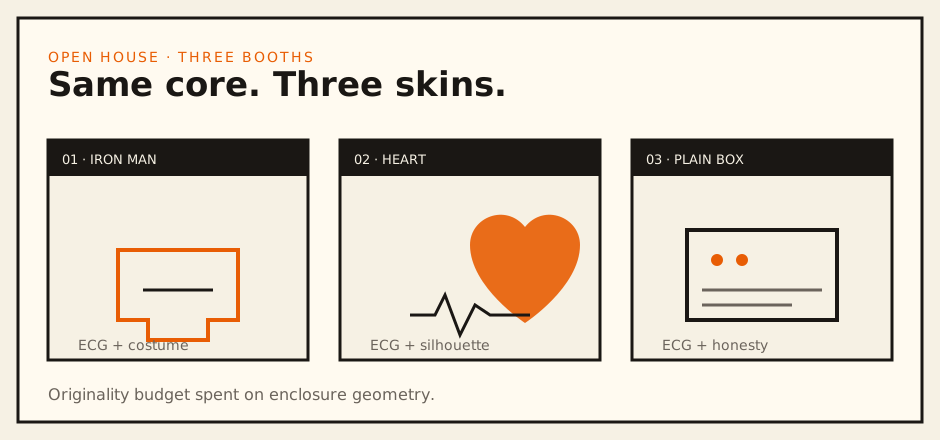
One looked Iron Man. One was heart-shaped. One was a plain box with wires. Different shells. Same assignment energy. Nothing inside felt like a real step past what already existed. I left annoyed and slightly bored — proud booths for devices that felt already solved, just uglier and slower.
I thought the students were uncreative.
Now I am year four, in the medical device course, fresh off a hospital consult — and the real mechanism finally clicked. It was not a creativity shortage. It was the incentive stack.
The consult
We sat with a rehab clinician for about an hour. The first half was a long needs monologue, and the clinical part was real.
PT and OT about an hour each at best. Rest of the day: bed. Sit the patient out on a Jerry chair and they stare at nothing while nurses run to the next transfer. Intensity matters in the recovery window, but standing work raises fall risk. Elderly setup cannot be Bluetooth hell — switch on, press start. Infection control if anything is wearable. Feedback patients can see: reps, degrees, goals. Mild-to-moderate stroke first; dense bed-bound patients are a different machine. Two need statements on the table: more activity outside therapy, and assistive help for ADL without a full-time carer strapping you in.
Useful. Concrete. The kind of brief that should force a sharp product decision.
Then notice what the default brief optimised for.
Needs, severity bands, donning, cleaning, feedback, FITT-ish dose. That is the language of a workable student device. What machines already own this job, what they win on, where they die in a real ward — that was not the spine of the opening. It came later, mostly when students asked.
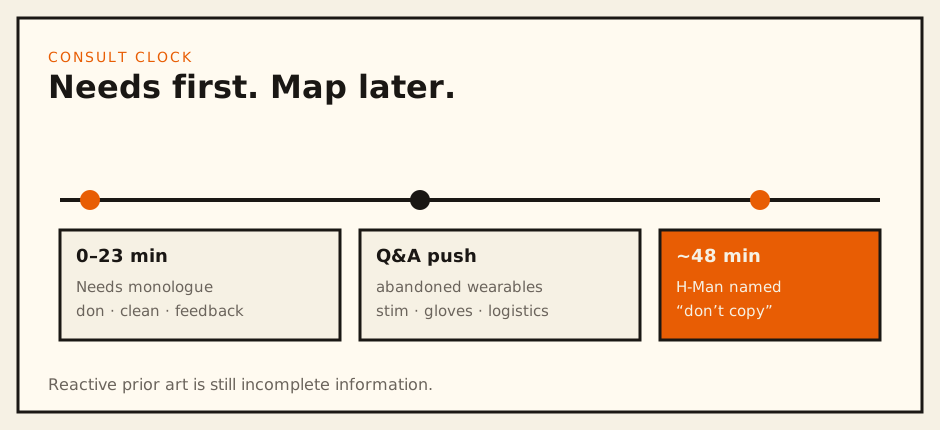
What only showed up when we pushed
Abandoned devices? Wearables. Not because the sensor math is fake — because compliance, who dons it, who charges it, Bluetooth friction, elderly patients hiding a dead battery, and eventually rejection. Camera-based might dodge wear and charge, then dies on setup: lens must face the patient, nothing blocking, fragile geometry.
Stimulation? They already use plain electrical stim as standard of care — shoulder, foot drop, wrist assist when you cross a threshold. Not magic advanced kit. Coordination still weird because the whole muscle bundle fires at once.
Finger gloves? Go Taobao or Shopee — pneumatic stretch gloves exist. Early stroke needs less force; chronic contracture is another problem.
That is prior art. It is also reactive prior art. You get fragments when someone asks the uncomfortable question. You do not get a clean competitive map on the table at minute one: installed base, cost, workflow kill-shots, who still uses the thing after the pilot photo.
Holes where the landscape should be are not neutral. Students aim at vibes they can demo.
Then I said H-Man
Near the end I asked about H-Man trials.
Instant recognition. Almost a double-take. Wow, you know about H-MAN.
Then the facts that should have been on slide one of any serious design brief:
- Inpatient they run a similar robot — another brand, from China
- H-Man itself more outpatient / day clinic, plus home-trial direction
- Outcomes talked about as positive; cost-effectiveness gets mentioned
- Planar handle, 2D path, assist-to-target when you cannot finish the reach
- Shoulder and elbow, not fingers — fingers are a different suitcase machine you can send home
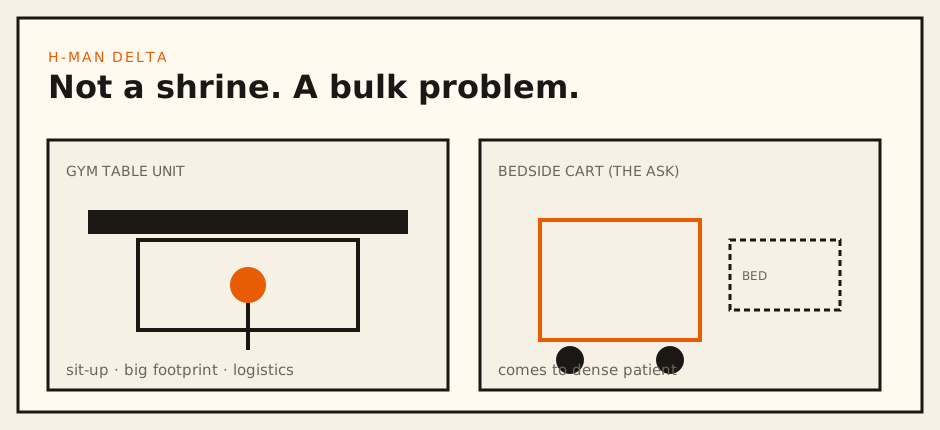
- Gym-corner deployment sounds nice until logistics: who pushes the patient, who monitors, space
Useful. Specific. Still student-pulled.
Then the line that stuck harder than the clinical requirements:
Something similar can be designed — but do not design something exactly the same. We do not need another H-Man.
Follow-up on bulk: if you can miniaturise and still do the activity, great. Dense patient who can only lie in bed cannot use the big table robot anyway. A cart that comes to bedside would be a real answer.
I get the surface intent. Cloning a commercial robot for a student grade is a waste of a semester. The ward does not need a fourth machine that does the same handle path on the same footprint.
Good intention.
Bad outcome
Sit with the full system.
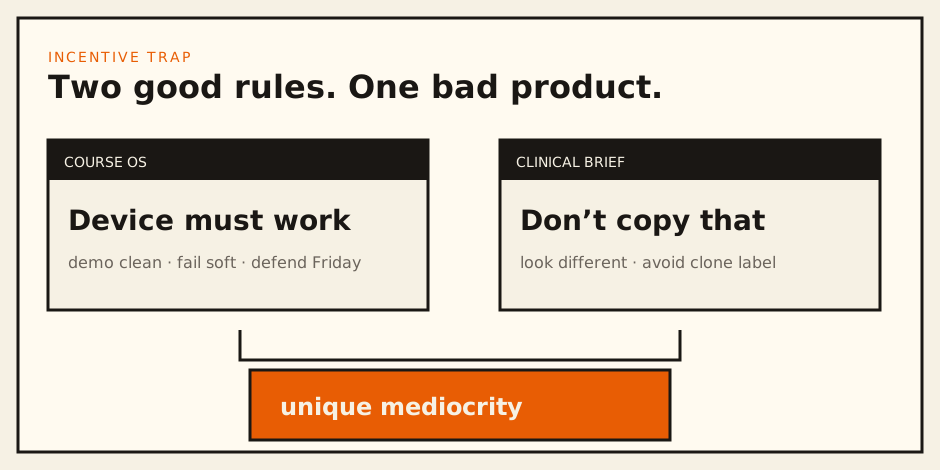
Course culture pays for a device that works — demo clean, fail soft, stay inside what you can defend on Friday.
Clinical briefing, when you finally name the incumbent, pays for not copying.
The same hour still front-loads needs and back-loads the installed base, mostly on Q&A.
So the rational student move is not "beat H-Man on the axis the ward still loses to."
It is "look different enough that nobody can say clone, while staying small enough that the demo cannot fail."
That is how you get Iron Man ECG and heart-shaped ECG.
Uniqueness as skin. Mediocrity as chassis.
In a healthy engineering culture, "don't copy" means: here is the prior art, here is the gap, your grade is the delta.
In the version I keep watching, "don't copy" arrives after a needs sermon, without a full prior-art dump up front, while "the device has to work" still runs the grading OS. Students are not stupid. They optimise the intersection:
- different silhouette
- known sensor
- known pipeline
- known demo script
- low chance of public failure
They are not building on top of the world's best boring machine. They are building a worse machine with a costume, then calling the costume innovation.
Open House was not three teams independently falling in love with ECG. It was three teams solving the same constrained game and spending their originality budget on enclosure geometry.
H-Man is not sacred either
Here is the part people miss when they treat "don't copy H-Man" like a purity rule.
H-Man is already a bulky, specific tool. Planar. Table. Sit-up patient. Gym logistics. Handle path for shoulder and elbow. Useful in the right lane. Not a shrine. A polytechnic student with basic mechatronics can reproduce the idea of "handle + assist-to-target on a plane" without touching the commercial unit's real engineering, regulatory, and service stack. The hard parts are not the LinkedIn silhouette. The hard parts are reliability, workflow, evidence, and the unsexy constraints the transcript actually named: space, who pushes, who monitors, bedside reach, dead batteries, infection wipe-down, elderly setup friction.
So the instruction cannot just be "don't copy."
It has to be "here is what already works, here is why wards still hate it, your job is one honest step past that hate."
Without that, fear of copying just bans the only serious reference class students can name — and leaves them free to reinvent weaker toys with cuter lids.
Incomplete information is not neutral
When the installed base is under-described until someone forces the names, it does not protect originality. It protects confusion.
Students cannot aim at a gap they cannot see. They aim at unique, helpful, feasible, demoable. The market already ate the easy versions of those vibes. What remains in a one-semester box is decorative differentiation around a solved core — or a safe re-implementation with worse materials and less time.
That is not how fields move. Fields move when the last machine is on the table, ugly parts included, and the next team is graded on what they changed that matters: setup time, bedside reach, adherence, cost per useful rep, staff load, infection control, home carry, proof.
Copying the solid substrate and attacking one real failure mode is progress.
Banning the substrate and grading a working novelty shell is cosplay.
This is bigger than one consult
I already wrote the other half: the device has to work. That line is Singapore schooling compressed into a project meeting — pass over exploration, score over substance, private notes over compounding public artifacts.
This consult is the twin failure mode.
We want students to look original.
We train them to fear looking derivative.
We still pay them for safe function.
We still hand them half a map of what exists, and call the map complete because the clinical pain was vivid.
Of course the batch produces unique mediocrity. Heart-shaped ECG is not a mystery. It is the equilibrium.
You can dress this as Asian exam culture or Chinese drill culture or Singapore face culture. The mechanism is simpler than the civilisation essay: when the scoreboard hates visible failure and the brief hates visible lineage, people invent originality that cannot threaten either.
No boundary broken.
No incumbent embarrassed.
No demo risked.
A new colourway of the same object.
Good intentions. Bad outcomes.
What I want instead
Put the machines on the table on day one. Strengths. Weaknesses. Price. Who actually uses them after the pilot photo. Wearables that died on charging. Robots that work in clinic and stall in the ward. Stim that is already standard of care. The China unit next to H-Man. The suitcase finger machine. All of it.
Say out loud: steal the parts that work. Cite them. Then move one constraint the ward still loses to — bulk, bedside, compliance, staff minutes, not the paint job.
Grade the delta, not the costume.
Grade the postmortem when the ambitious path dies.
Grade whether next year's group can start from your repo instead of your silence.
"Don't copy that" only becomes a good sentence after "here is exactly what that is, and here is the hole it leaves."
Until then, Open House will keep smelling the same. Three booths. One sensor. Three skins. Everyone proud. Nobody further.